

Shared Instrumentation Core (ALS 3139, ALS 3131)
- The equipment in our multi-user rooms ALS 3139 and ALS 3131, is available for use for trained users.
- Apply for instrument room access and training and a RELMS account.
- Reserve time through RELMS calendar for the instrument. You may need training before access is granted.
- Use of any of our equipment in ALS 3012 is still by appointment only with the appropriate PPE.
- Shared Instrumentation – BioTek Synergy H1 Plate reader, NanoDrop One spectrophotometer, Qubit, ABI Absolute Q digital PCR, ABI 7500 real-time PCR, Azure c600 Gel Imager, BioRupter, SpeedVac, Qiagen TissueLyser II
Training and Access Information
- You can fill out information request access to instrumentation.
- Training, access to instrument use and reservation calendars are done primarily done through RELMS, Research Equipment & Lab Management System.
- An account in RELMS will be needed for access. Fill out the account request form. No payment is needed for non-billable calendars.
- In RELMS, login, go to the CQLS Shared Instrumentation and Microscopy facility and click on the calendar of the instrument you are interested in accessing.
- You will get a response "The [instrument] requires approval to reserve. Would you like to be contacted by the facility for access or training?" Respond YES and we will get back to you with training information and access.
- We ask that you make a reservation in RELMS, under the Shared Instrumentation facility both to use the instrument and for others to know when it is in use. Tracking usage helps maintain continued support for instrumentation. Calendar access will allow you to see the calendar in RELMS or get any notifications about service or closures or issues.
- Some core facilities are available with the encrypted orange OSU ID card
- After hours Instrument room access can be requested for some usage.
- Access is contingent on appropriate usage and PI approval.
- Contact or Core Lab Staff or 541-737-3413
- The BSL2 Core Lab at ALS 3012 is locked. Use of any of our equipment in ALS 3012 is still by appointment only with the appropriate PPE. You can make an appointment or contact an individual person
Instruments
ALS 3139 Open 8:30am-5pm M-F Card Access after hours
ALS 3131 and ALS 2070 Card Access Entry
Contact lab staff for more information on instruments or training not listed below.
| Image |
Shared Instruments |
Calendar |
ALS Room | Training |
Resources |
|---|---|---|---|---|---|
|
Image
|
|
3139 | CANVAS, In-Person |
Software: 7500 FAST System SDS v 2.3 (and v 3.2 High Resolution Melting (HRM) software. |
|
|
Image

|
|
3139 | CANVAS, In-Person | Software: Absolute Q Digital PCR Software v6.2.1 | |
|
Image
|
|
3139 | CANVAS, In-Person |
|
|
|
Image
|
|
3139 | Request Access | Nanodrop One Manual | |
|
Image
|
Qubit Fluorometer | 3139 | Request Access |
|
|
|
Image

|
|
3139 | In-Person | ||
|
Image
|
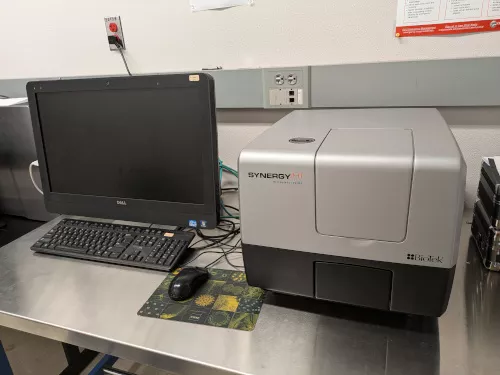
BioTek Synergy H1 Hybrid Multi-Mode Plate Reader | 3131 | CANVAS | ||
|
Image

|
Keyence BZ-X710 Fluorescent microscope | 3131 | CANVAS | ||
|
Image
|
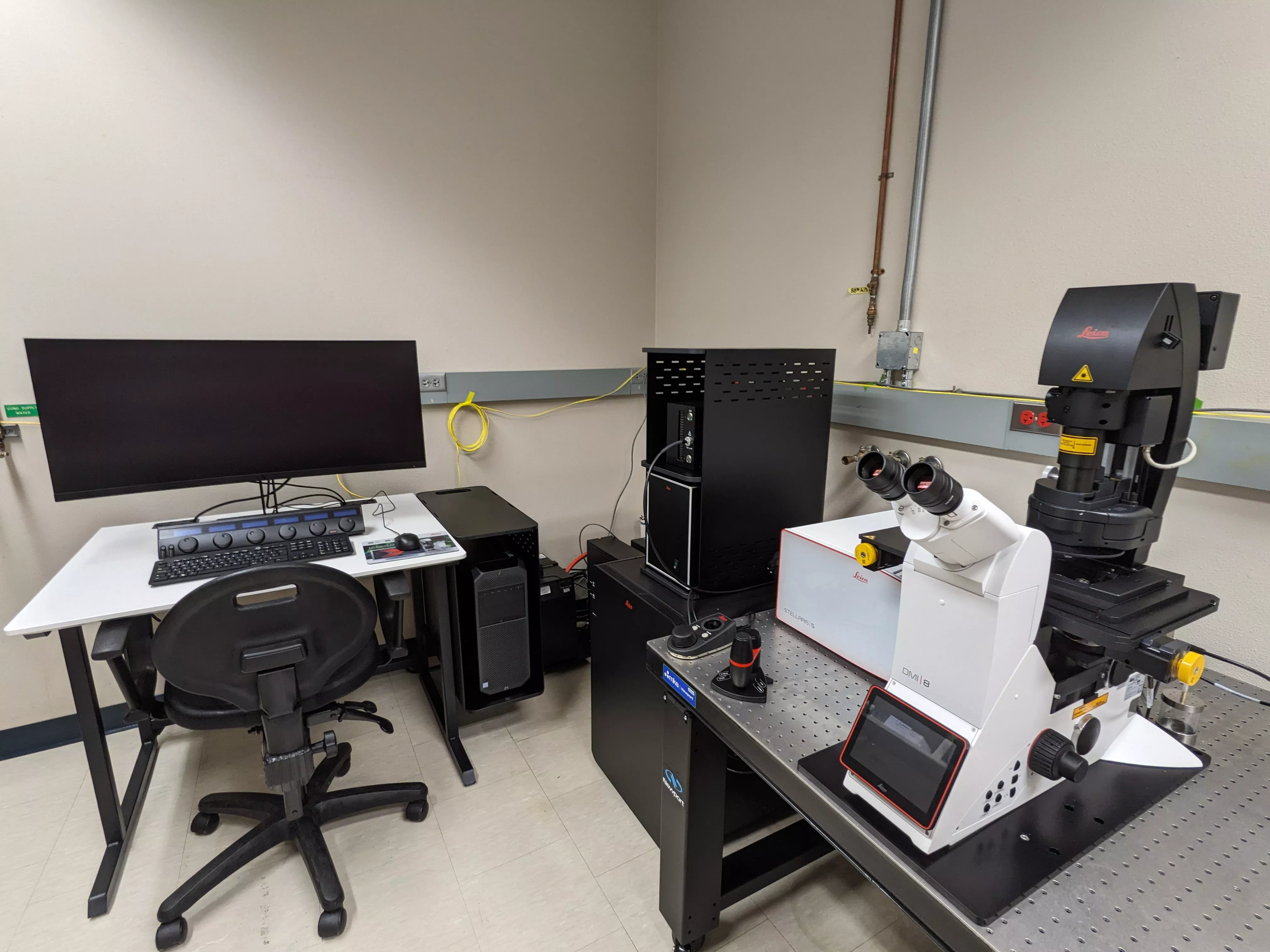
Leica Stellaris 5 Confocal Microscope System | 2070 | CANVAS, In-Person | ||
| LASX Microscope Analysis Workstation | 2070 | Request Access |
ABI 7500 FAST Real-Time PCR System
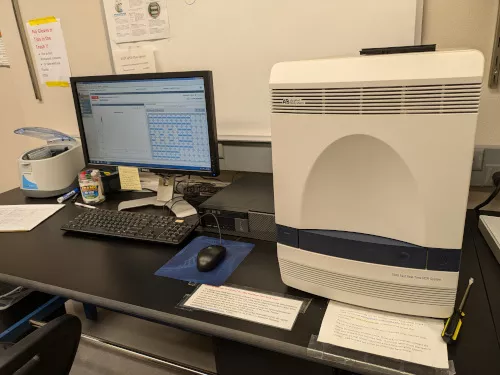
The ABI PRISM® 7500 FAST Sequence Detection System is a fully integrated system for real-time detection of PCR. (Note: Currently HRM v3.2 also installed for High Resolution Melting experiments. Contact before use about calibration and mastermix). The system includes a built-in thermal cycler, a tungsten-halogen lamp to induce fluorescence, CCD (charge-coupled device) detector, real-time sequence detection software and high resolution melting software. Detection capabilities allow for SYBR, TaqMan and SYTO9 reagents applications. The 7500 FAST can process qPCR samples in 40 minutes (not including dissociation curve) with the appropriate chemistry. Supported dyes are FAM™, SYBR®, VIC®, ROX™, NED™, TAMRA™ dyes (Cy®3, Cy®5, and Texas Red® )
- The investigators are responsible for purchasing all consumables.
- Plates AB: part number 4346906
- 8-strip tubes: part number 4358293
- Caps for 8-strip tubes: part number 4323032
PCR Resources
- Software for use in your lab (set up templates to run, analyze data) can be downloaded from this link. Please review the Release Notes file with information on the operating systems compatible with installing the new software.
- Thermo Fisher has an excellent resource center for real-time PCR
QuantStudio Absolute Q Digital PCR
The QuantStudio Absolute Q Digital PCR has more sensitivity than qPCR so is ideal in quantification of low count or expression experiments. Setup is similar to qPCR reaction setup. Compartmentalization, thermal cycling, and data acquisition are all done on the instrument in as little as 90 minute acquisition time. FAM, HEX (not field calibrated), VIC, ABY, ROX (QC channel), CY5, and JUN dyes are supported. As little as 4 samples can be run at a time with 16 samples on a MAP16 plate.
Azure c600 Imager
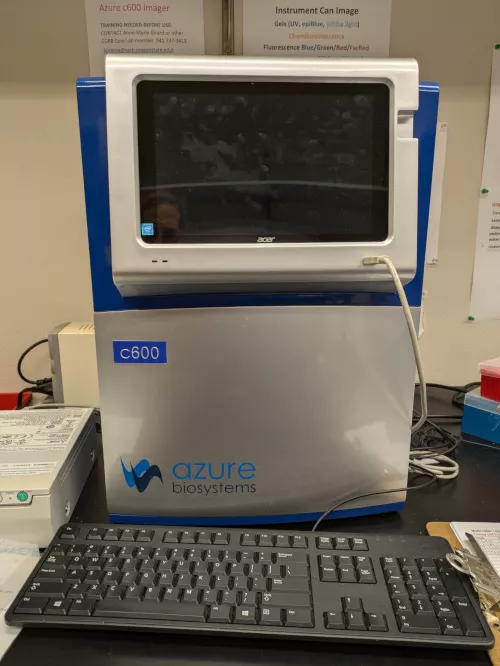
The system will detect labeled DNA, RNA and proteins or other labeled molecules on blots, gels or other substrates for qualitative and quantitative assays. Having the capacity for both chemiluminescence, fluorescence and IR will allow labs to detect multiple species of molecules in a single experiment. This imaging system supports applications of IR and Visible Fluorescent Westerns, Chemiluminescent Westerns, IR and Visible Fluorescent Protein Arrays, and DNA and Protein gel imaging, colorimetric and photometric imaging.
The system has Illumination light sources
- 2 sets of infrared, solid state laser diodes emitting at 660nm +/-3nm, and 785nm +/-3nm respectively for excitation with detection of IR fluorescent dyes at (710-730nm) and (815-830nm)
- Three Channel RGB Excitation – For Cy5/Cy3/Cy2 applications. 3 sets of LEDs for excitation of dyes excited in the blue (457nm), green (530nm), and red (628nm) spectrum of visible fluorescence for multiplex imaging of dyes.
- epi-blue LEDs (470nm) for excitation of DNA gels stained with SAFE fluorescent dyes like SYPR Safe dye.
- Dual wavelength UV transilluminator at 302nm and 365nm light source for DNA applications and various dyes (exmpl: SYBR® green, SYBR gold, SYPRO® orange, fluorescein, RadiantRed®,Texas Red®, SYPRO Red. ) Please note that use of Ethidium Bromide is forbidden on this instrument.
Nanodrop One
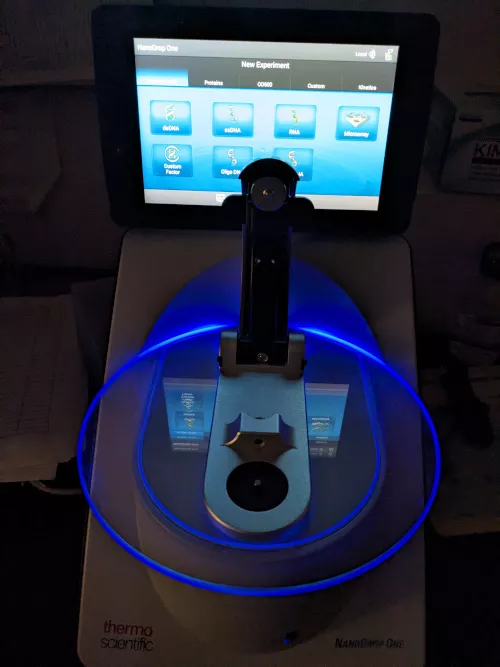
The NanoDrop One UV-Vis Spectrophotometer enables highly accurate analyses of samples as small as 1µl.
Users are required to provide pipets, pipet tips and gloves.
The Nanodrop has the following characteristics:
- full-spectrum UV-Vis absorbance analyses (190–850 nm ±1 nm)
- for measuring absorbance of DNA, RNA, dyes, proteins
- 1-2 µl of sample
- Maximum concentration 27,500 ng/µL of dsDNA, 820 (400) mg/mL BSA
- No dilutions for most samples
- 8 second measurement
- Detect contaminants such as phenol and protein in nucleic acid samples, or DNA and phenol in protein samples
Qubit Fluorometer
The Shared Instrumentation core has an older Qubit 1.0 available for use. The Qubit quantitation platform is a simple, selective, and highly sensitive method for detecting DNA, RNA, or protein. As little as 1 uL of sample can be used. These assay kits and tubes from Invitrogen can be used with the Qubit. A few newer assays do not work with the Qubit 1.0 version such as the Qubit™ RNA IQ Assay. In addition, the Quant-iT kits contain fluorescent dyes that are specific to the biomolecule of interest and can also be used with the Qubit. See the Quant-iT assay protocol.
- The Core Facilities does not supply tubes or assay kits for operating the Qubit
- 10011-830 Axygen PCR-05-C tubes (from VWR)
- Q32856 Qubit assay tubes, 500 tubes
Qiagen Tissuelyser II
The Qiagen TissueLyser II is available for use after training. Contact Lab staff to schedule in-person training.
BioTek Synergy H1
The BioTek Synergy H1 is a modular multimode microplate reader, with both monochromator-based optics and filter-based optics
- Absorbance 230 to 999 nm. OD range 0.000 to 4.000 OD
- Fluorescence excitation/emission range 250–700 nm
- Fluorescence bandwidth can be set between 9 and 50 nm, in 1 nm increments
- Microvolume analysis with Take3 plate measures up to 16 samples in one run
- Bioluminescence module available
- Special plates needed for UV