

The Illumina NGS sequencing service operates three instruments: NextSeq2000, MiSeq i100 and MiSeq. The Genomics Core offers library prep and QC services prior to sequencing. Please contact Mark Dasenko with any questions regarding library prep and sequencing submission. Questions regarding the sequencing data output can be addressed by Justin Elser.
Illumina NextSeq2000

More information about the NextSeq 2000 can be found on the specification sheet. There are four different sizes of flow cells available for the NextSeq 2000 that provide the following output:
- P4- 1.8 billion paired reads/run
- P3- 1.2 billion paired reads/run
- P2- 400 million paired reads/run
- P1- 100 million paired reads/run
The following read lengths are available:
| Run Type | Run Configuration |
|---|---|
| P4 300 cycle | Paired End 2x150 bp |
| P4 200 cycle | Paired End 2x100 bp |
| P4 100 cycle | Single End 100 bp or Paired End 2x50 bp |
| P4 50 cycle | Single End 50 bp or Paired End 2x25 bp |
| P3 300 cycle | Paired End 2x150 bp |
| P3 200 cycle | Paired End 2x100bp |
| P3 100 cycle | Single End 100 bp or Paired End 2x50 bp |
| P2 600 cycle | Paired End 2x300 bp |
| P2 300 cycle | Paired End 2x150 bp |
| P2 200 cycle | Paired End 2x100 bp |
| P2 100 cycle | Single End 100 bp or Paired End 2x50 bp |
| P1 600 cycle | Paired End 2x300 bp |
| P1 300 cycle | Paired End 2x150 bp |
| P1 100 cycle | Single End 100 bp or Paired End 2x50 bp |
Submit a NextSeq 2000 sequencing request in RELMS.
Illumina MiSeq i100
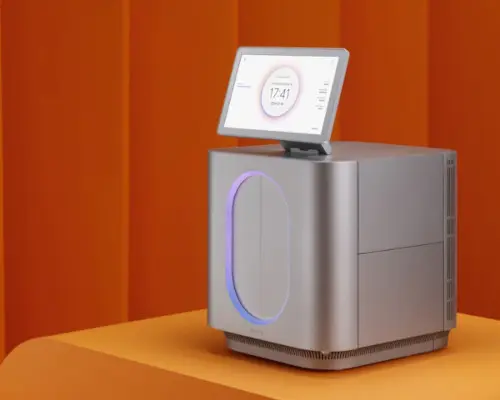
More information abou the MiSeq i100 can be found on the specification sheet. There are two different sizes of flow cells available for the MiSeq i100 that provide the following output:
- 25M - 25 million paired reads/run
- 5M - 5 million paired reads/run
The following read lengths are available:
| Run Type | Run Configuration |
|---|---|
| 25M 1000 cycle | Paired End 2x500 bp |
| 25M 600 cycle | Paired End 2x300 bp |
| 25M 300 cycle | Paired End 2x150 bp |
| 25M 100 cycle | Single End 100 bp or Paired End 2x50 bp |
| 5M 600 cycle | Paired End 2x300 bp |
| 5M 300 cycle | Paired End 2x150 bp |
Submit a MiSeq i100 sequencing request in RELMS.
Library Prep Types
We offer several kinds of library prep for Illumina sequencing. These include:
- RNA-seq
- -Whole transciptome (mRNA enrichment or rRNA depletion)
- 3'-Taq-Seq (QuantSeq FWD and QuantSeq Pool)
- DNA-seq
- Whole genome (mechanical shearing or tagmentation)
- Targeted amplicon (16s, ITS, 18s, etc.)
- Custom library preps are also available upon request. Some examples include.
- small RNA
- ChIP-seq
- Methyl-seq
- Target Enrichment
Consult with us to determine the type of prep best for your experiment in addition to the quality and quantity requirements for samples. We accept libraries prepared by you as long as it fits into the parameters necessary for the Illumina sequencer.
Submit a library prep with sequencing request in RELMS
Hints For All Preps
Quality: A better quality sample will give a better library. gDNA should have absorbance ratio values A260/A280 of 1.8–2.0. Longer length genomic DNA is better and for some preps necessary. RNA quality should be checked with the bioanalyzer before library preps and is not included in the fee. RINs of 8-10 are best for most preps. If the RIN is less, talk to us about possible preps.
Quantity: We appreciate more DNA or RNA if you have sufficient material, especially if you have determined concentration by a spectrophotometer such as nanodrop rather than a fluorometric method such as Qubit. We will double check the concentration with the Qubit fluorometer before starting, then use the appropriate volume needed for the specific prep being used. Fluorometric quantification is included in the library prep fee.
Size Determination: After library prep is complete, the size distribution must be checked with the bioanalyzer HS-DNA chip or TapeStation HS DNA tape. This is not included in the prep fee.
Library Quantification: After library prep is complete, the concentrations will be checked by fluorometer, Qubit or fluorescent plate reader. This is included in the prep fee. A final concentration measurement by qPCR is required prior to sequencing on each library or the pool of libraries. This is not included in the prep fee.
Pooling: Library pooling is included in the library prep fees. Let us know how you would like your libraries pooled and in what ratios before we start the prep. Selection of barcodes for the pool is important to plan before library prep is started.
Library Sample Submission
- To submit a samples for sequencing, please submit an Illumina Sequencing Request in RELMS.
- Please provide us with 30 uL (if possible) of 10 nM sample in Qiagen buffer EB (Tris-Cl 10mM, pH 8.5) supplemented with 0.1% Tween-20 (optional). Molar concentration sample calculation below:
Library concentration = 40ng/µL
Median size fragment = 170bp
Library molecular weight = 170bp × 650g/mol per bp = 110500g/mol
Molar concentration = 40ng/µL / 110500ng/nmol = 0.000362nmol/µL
= 0.362µM
= 362nM
- We will perform a final quantification of your library by qPCR to get the most accurate concentration measurement.
- We don't require libraries to have the sizing checked on the BioAnalyzer/TapeStation, but it is highly recommended. Sizing info is needed in order to get accurate molar concentrations for determining sequencing loading. If library sizing is not checked, then you much provide us with the median fragment sizing info.
- We will spike-in a PhiX control library into all Illumina runs. Typically 1% spike-in for high base diversity libraries (eg. whole genome, RNAseq) and at least 10% for low base diversity libraries (eg. amplicon libraries).
- All primary data and the data generated by the Illumina data analysis pipeline will be available for only 2 weeks on the CQLS file servers. Therefore, researchers will need to copy their data onto a file server they own or a collaborator's file server. External customers have the option of downloading their data via the web or providing an external USB hard drive. If you have questions about the computational requirements for downstream analysis of your data and/or access to file server space, please contact HPC Support.
- Please drop off samples to the -20 freezer in Agricultural and Life Science (ALS) 3139. For off campus users, please mail samples frozen on ice to the following address:
Mark Dasenko
Center for Quantitative Life Sciences
Oregon State University
3012 Agricultural & Life Sciences Building
2750 SW Campus Way
Corvallis, OR 97331-8646